The factory floor may be modern. The information around it often is not.
Industrial businesses are full of systems, equipment, procedures and experienced people. Yet important operational information can still live in spreadsheets, paper records, disconnected databases, email threads or the memory of the person who has been doing the job for twenty years.
The opportunity is not to 'digitize manufacturing' as an abstract idea. It is to make information move with the work so people can make faster decisions with less chasing, duplication and uncertainty.
What a better industrial operation feels like.
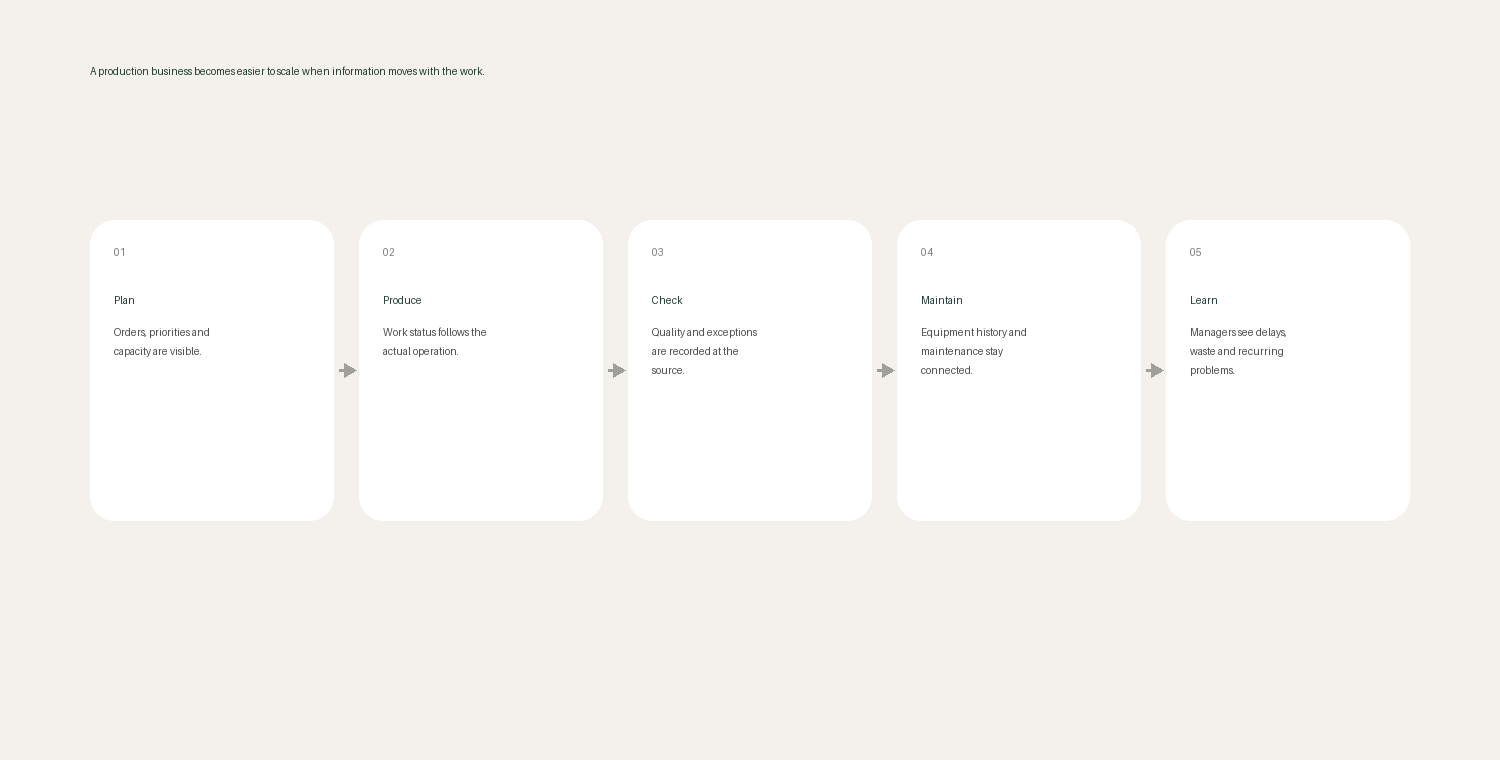
The order, production status, inspection, exception, maintenance activity and final outcome create one connected trail. A supervisor can understand what is happening without waiting for a spreadsheet. Maintenance can see the history behind the machine. Quality problems can be traced back instead of rediscovered.
The purpose is not to make the factory look digital. It is to help the operation learn from itself.
AI becomes valuable when it can work with your operating knowledge.
Industrial AI is most useful when it is grounded in the company's own context: procedures, manuals, maintenance records, inspection history, production information and technical documentation.
A technician or supervisor should be able to ask a practical question and retrieve the right context quickly. Management can use AI to summarize exceptions, surface recurring issues, or help teams work through large amounts of operational information without turning every task into manual analysis.
Some companies modernize their own plant. Others see a vertical software opportunity.
A textile manufacturer may need better quality, production or maintenance workflows internally. An industry specialist may recognize that dozens of factories face the same problem and decide to build a focused SaaS product around it.
We are interested in both conversations because the strongest vertical software often starts with someone who deeply understands the operational problem.
Our experience sits close to the operational side of industry.
We have built an industrial field-service platform around assets, recurring maintenance, technicians, client access, notifications and AI-assisted technical knowledge. The client identity is confidential.
We have also worked with industrial and enterprise organizations across steel, automotive performance, supply-chain technology and large catalog/integration environments where reliability, complex data and ongoing operations matter as much as the interface itself.
Where custom software can create leverage.
- Maintenance and asset history
- Production workflow visibility
- Quality and inspection workflows
- Document and SOP management
- Technician and workforce knowledge systems
- Inventory and material integrations
- Supplier and customer portals
- Approvals and exception handling
- Dashboards and operational reporting
- Legacy system/API integration
- AI-assisted knowledge retrieval
- Vertical SaaS products for specialized industrial markets
Frequently Asked Questions
Do you replace ERP systems?
Usually that is not the starting assumption. We first identify where the real operational gap exists and determine whether the better answer is integration, a focused custom layer, or replacement of a specific workflow.
Can you connect modern applications to legacy databases or systems?
Yes. API layers and staged modernization can preserve valuable existing systems while giving users better workflows and interfaces.
Can AI work with maintenance manuals and SOPs?
Yes. Retrieval-based systems can use approved internal documentation to provide context-specific assistance.
Can you build software for one manufacturing niche?
Yes. Narrow vertical software can be especially valuable when a process is poorly served by generic products.
Where does your operation still rely on someone knowing who to call, which spreadsheet to open, or where the real answer lives?
That is usually where the most useful modernization opportunities begin.