Your business should not get harder to run just because more customers are saying yes.
For many contractors, growth creates a strange problem. More work is good, but every new crew, customer, service area, estimate, reschedule and follow-up creates another thing someone has to coordinate manually.
Owners and operators often reach a point where they are still delivering good work, but the business is being held together by calls, messages, spreadsheets, memory and people who know how to 'make it work.' We are interested in helping those businesses build the systems that let growth feel controlled instead of chaotic.
If you run a growing service company, this probably feels familiar.
The estimate is in one place. The job photos are on someone's phone. A customer asks for an update and the office has to call the crew. Scheduling changes ripple through the day. Follow-ups happen when someone remembers. The owner can feel the company is busy but still cannot see the whole operation clearly.
- Leads are captured differently depending on who answers.
- Estimating and job details do not always travel together.
- Crews need information that lives back at the office.
- Customers expect faster updates than the team can manually provide.
- Photos, notes and approvals become difficult to find later.
- More revenue starts creating more admin overhead.
What a better operation feels like.
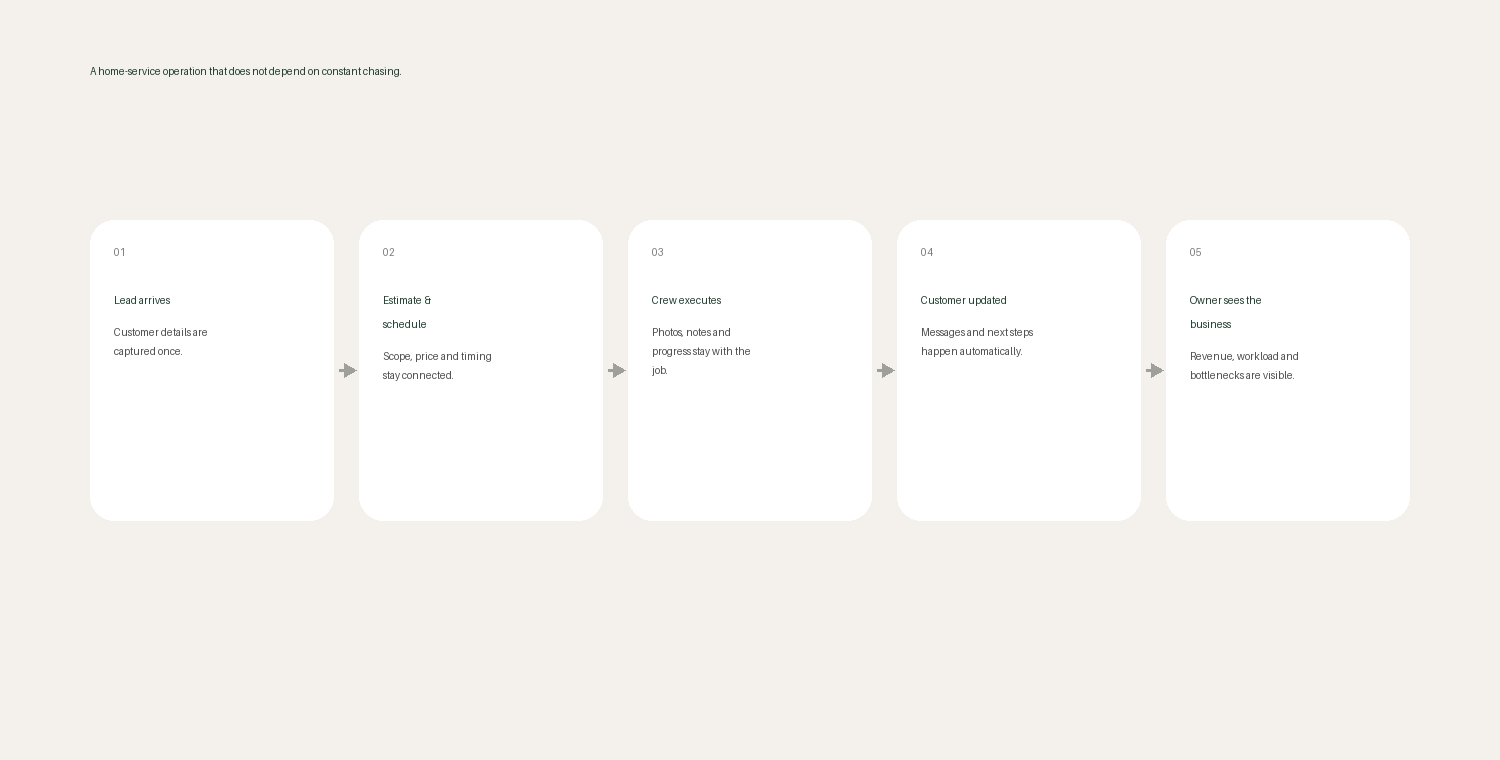
A customer enquiry becomes an estimate without being re-entered. The approved job becomes a schedule. The crew arrives with the scope, history, photos and instructions already attached. Progress updates stay with the job. The customer knows what is happening. The invoice follows the work. The owner can see workload, revenue and bottlenecks without asking five people first.
Technology should make a service business feel more organized as it grows, not give the team another application to babysit.
AI becomes useful when it removes little pieces of friction all day long.
AI is not the reason to rebuild an operation. First, the work has to be structured. Once estimates, jobs, customer history, service notes, photos, documents and schedules are connected, AI has context it can actually use.
That can mean summarizing field notes, helping staff find previous work, drafting customer updates, extracting information from documents, assisting estimates, or helping technicians retrieve procedures without calling the office.
Some owners need better software for their own company. Others see a product opportunity.
A roofing operator may want a workflow that fits the way their teams actually inspect, quote and deliver work. An industry veteran may see that the same problem exists across hundreds of contractors and decide to build the SaaS product those businesses will subscribe to.
We work with both: companies modernizing their own operation and founders productizing a problem they understand deeply.
Why this industry makes sense for us.
We have worked on customer acquisition, bookings, service journeys and local-search architecture for home-service businesses, and we have built deeper operational software in adjacent field-service environments covering scheduling, customer access, asset history, mobile workflows, notifications, reporting and payments.
That combination matters because a contractor does not only need software that functions. The customer-facing journey and the operational workflow behind it have to support each other.
Where software can create leverage.
- Lead capture and qualification
- Estimating and quoting
- Scheduling and dispatch
- Crew and technician mobile workflows
- Job photos, notes and documentation
- Customer portals and automated updates
- Recurring maintenance and service agreements
- Invoices, payments and financing workflows
- Inventory and materials coordination
- Operational reporting and profitability visibility
- AI-assisted knowledge and communication
- Vertical SaaS architecture for founders building contractor products
Frequently Asked Questions
Do you build replacements for products such as generic contractor software?
When a standard product no longer fits the business, yes. We can also connect or extend existing systems when replacing them would add cost without solving the real problem.
Can you build software for one contractor business only?
Yes. Internal operational platforms are often valuable when the company's process is a competitive advantage or unusually specialized.
What if I want to build a SaaS product for contractors?
That is also a strong fit. We can design the multi-tenant product, subscriptions, permissions, mobile workflows, billing, analytics and AI capabilities around the market you know.
Can you add calculators or customer-facing tools?
Yes. Interactive estimators, assessments and planning tools can support lead generation while also demonstrating the type of digital experience your business can provide.
What part of your operation gets harder every time the company gets busier?
Show us where the handoffs, delays, duplicate entry, chasing, or visibility problems happen today. We can help determine where better software would actually create leverage.