Your field team should spend less time chasing information and more time doing the work.
The work itself is often not what slows a growing field-service business down. It is everything around the work: scheduling, job context, maintenance history, customer updates, paperwork, technician handoffs, reporting, and the constant back-and-forth between office and field.
We work with operators, founders, and product visionaries who look at those frictions and think: this should work better.
You have probably felt this already.
A technician calls the office because the latest history is not in front of them. A maintenance record lives in one system, the customer conversation in another, and the procedure they need is buried in a PDF or someone else's memory.
The business still gets the work done — because good people compensate for weak systems. But growth makes that compensation expensive.
- Jobs rely on calls, messages, and manual follow-up.
- Experienced technicians carry knowledge that newer staff cannot easily access.
- Customers ask for updates the office has to chase.
- Recurring maintenance is tracked through reminders, spreadsheets, or individual memory.
- Managers find out about delays after they have already become problems.
- More volume creates more coordination instead of more leverage.
Growth exposes the cracks.
Manual coordination can work surprisingly well when the team is small. The strain appears when the business adds technicians, serves larger customers, manages more assets, enters new regions, or takes on contracts with stricter service expectations.
At that point, the question is no longer whether the team can keep up. It is whether the operation can scale without adding another layer of administration every time revenue grows.
What a better operation feels like.
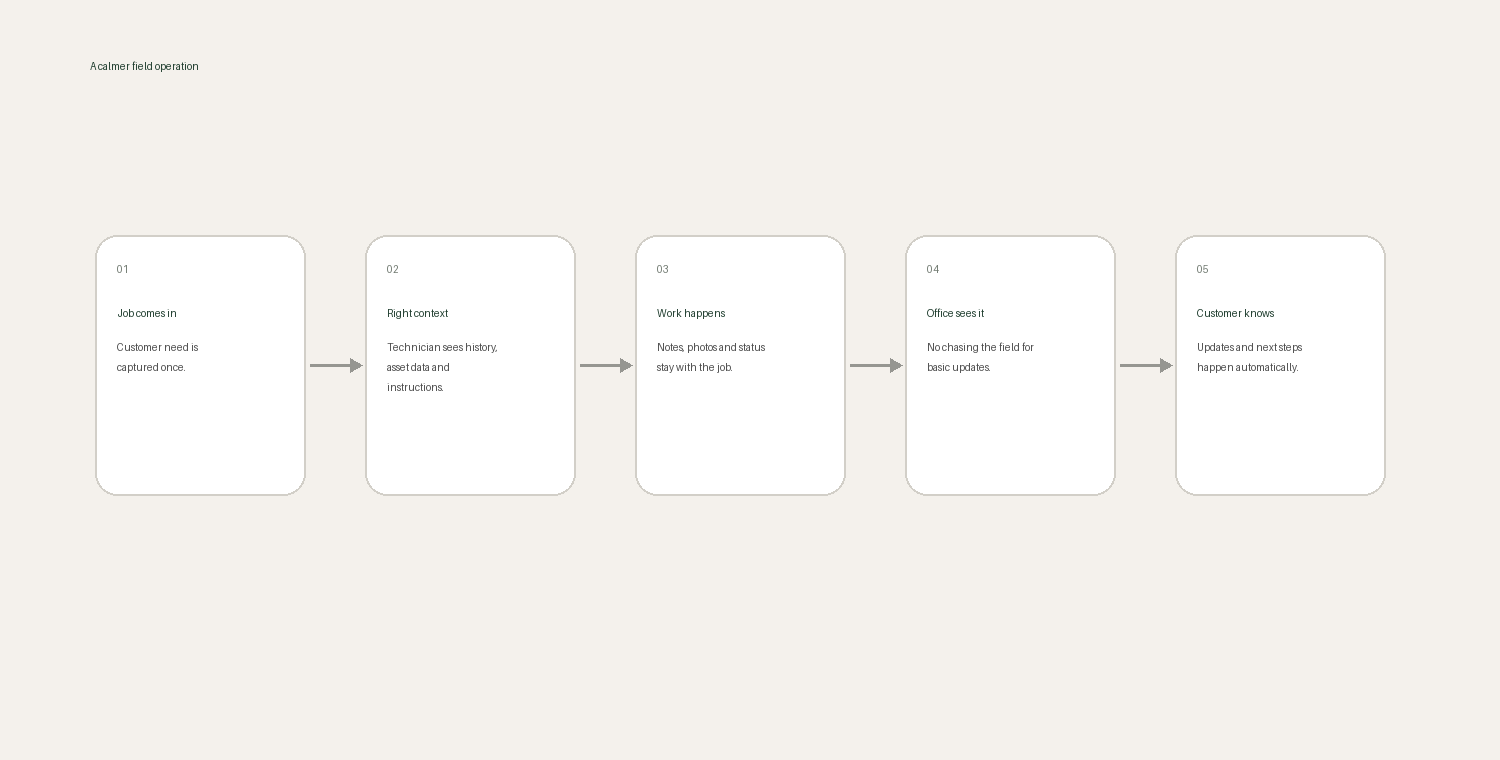
A technician starts the day already knowing where to go, what the customer needs, which asset they are working on, and what happened last time.
The office can see what is happening without constantly calling the field. Customers receive the right updates without someone manually sending every message. Maintenance history stays attached to the equipment. Managers can see what is overdue, what is coming next, and where the team is getting overloaded.
Good software should make the company feel calmer as it gets busier.
AI is especially useful when technicians need context in the field.
The value is not that a technician can chat with AI. The value is that the system can understand the context around the job and retrieve the right information while the technician is standing in front of the equipment.
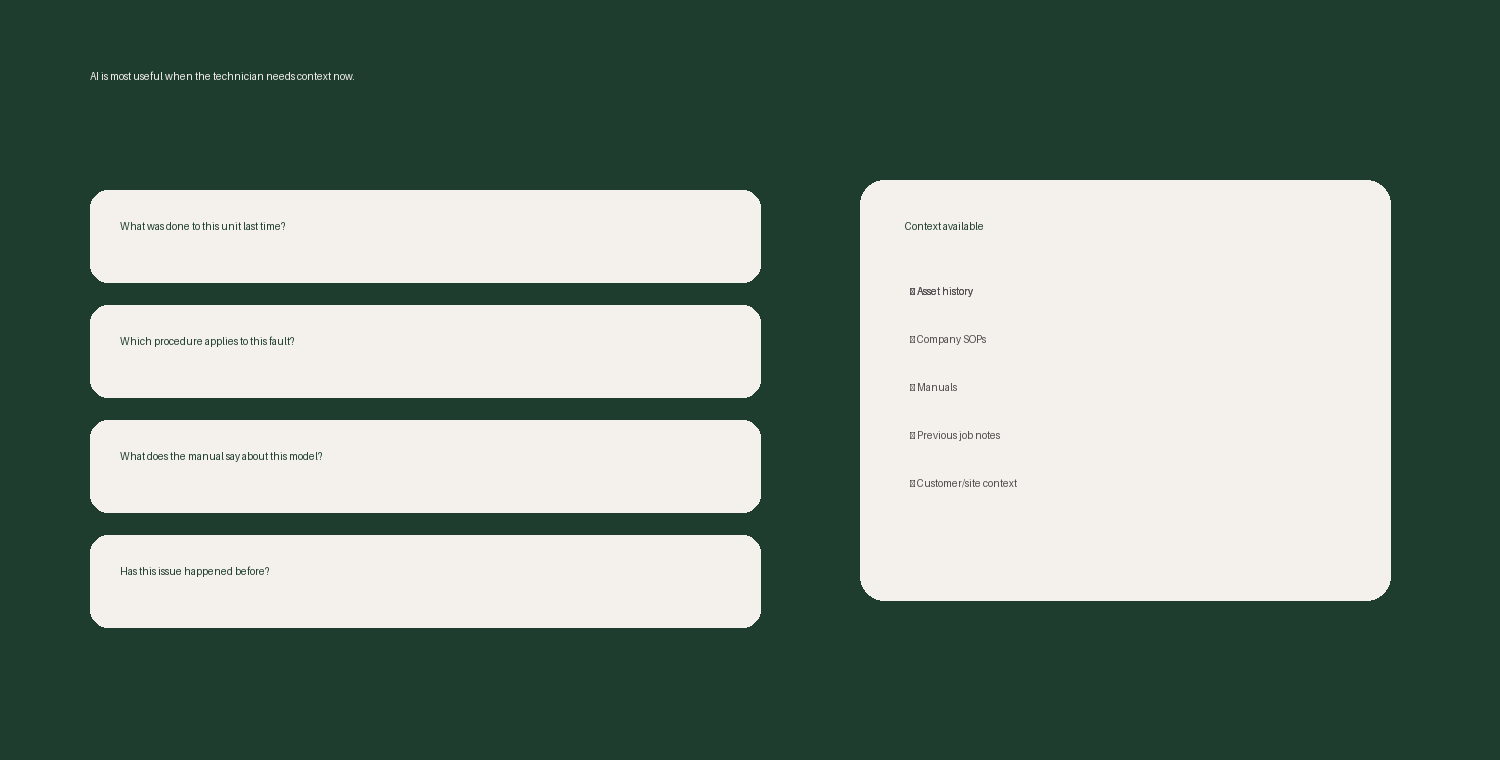
Instead of searching through manuals, folders, old job notes, or calling the office, the technician can ask a practical question and get an answer grounded in the company's own information.
- What was done to this unit last time?
- Which procedure applies to this fault?
- What does our documentation say about this model?
- Has this issue happened before?
- What should I check before I replace this component?
We have already built this kind of operational system.
For an industrial maintenance business, we built a multi-tenant field-service platform that brings together organization management, technicians, clients, asset records, maintenance schedules, assignments, timeline and calendar workflows, email and SMS reminders, and operational dashboards.
We also built an organization-specific AI knowledge layer so technicians could ask questions against company documentation, procedures, manuals, and technical instructions while performing work in the field.
The client identity is confidential, but the operational problem is not unusual: the company needed the knowledge, work history, schedules, customers, and field activity to stop living in disconnected places.
Automation should remove friction, not create another system to manage.
The strongest automation is often the work your team stops noticing.
A reminder goes out because a maintenance date is approaching. A customer receives a status update because the job moved forward. A manager sees overdue work without building a report. A technician's notes become part of the asset history without somebody retyping them later.
The point is not to automate everything. The point is to stop spending human attention on work the system can reliably carry.
There are two kinds of companies we usually want to meet.
The first is an established field-service business that has outgrown the tools holding its operation together and wants software designed around the way the company actually works.
The second is an industry expert, founder, or investor who sees the same recurring problems across the market and wants to build a SaaS product that other field-service companies can subscribe to.
One needs a better operating system for its own business. The other wants to build the operating system for an entire category. We work with both.
What we can help you turn into software.
- Technician scheduling and dispatch
- Asset and equipment history
- Recurring maintenance planning
- Mobile field workflows
- Customer and client portals
- Job notes, photos, files, and documentation
- Automated reminders and customer updates
- Inspections and service checklists
- Quotes, invoices, and payment workflows
- Operational dashboards and reporting
- AI knowledge assistants for technicians
- Multi-tenant SaaS architecture for founders building field-service products
The question is not whether software can do more. It is where better systems would give your business leverage.
For one company, that might mean cutting coordination overhead. For another, it might mean preserving technical knowledge before experienced staff retire. For another, the real opportunity may be turning an internal process into a product that hundreds of companies in the same industry would pay to use.
That is the conversation we are interested in.
Frequently Asked Questions
Do you build replacements for existing field-service software?
Yes, when the existing product no longer fits the business. We can also integrate or extend current systems when replacing them would create unnecessary cost or risk.
Can this work for a company with its own specialized workflow?
That is usually where custom software becomes most valuable. We start with how work actually moves through the business rather than forcing the operation into a generic template.
Can AI use our own technical documentation?
Yes. Retrieval-based AI can use approved company documents, SOPs, manuals, job history, and other internal knowledge to provide context-specific assistance.
What if we want to build a SaaS product for field-service companies rather than use it internally?
We work with founders and industry experts building vertical SaaS products as well. That can include multi-tenant architecture, subscriptions, mobile technician workflows, customer portals, permissions, billing, analytics, and AI capabilities.
What part of your operation still depends too much on people remembering, calling, checking, or chasing?
Show us how the work moves today. We can help identify where software, automation, or AI could reduce friction — whether you are improving your own operation or building a product for the industry.